
CERC — Environmental Software and Services

CERC news


< Previous12345678910111213141516171819Next >

16 Jul 2026New indoor-outdoor air quality modelling projects
CERC are very pleased to be part of the team awarded funding for a feasibility project looking at the influence of outdoor air quality on indoor exposures, and associated health outcomes. The project 'INdoor Health, Air pollution and Location-linked Exposure in the West Midlands' (INHALE-WM) will investigate how the location, structure and quality of domestic buildings shape residents' exposure to traffic-related air pollution in social housing. The study has been funded as part of the BREATHE IN EPSRC Micro Network +, which is addressing the relationship between population health and the built environment.
Dr Nana Wei at the University of Birmingham leads the team, bringing together expertise from CERC alongside researchers from the University of Reading, as well as Birmingham colleagues from the Department of Applied Health Sciences and the School of Geography, Earth and Environmental Sciences. Read more about INHALE-WM and the two other feasibility projects funded under BREATHE IN.
CERC are also part of the 'Indoor Habitability during the Transition to Net Zero Housing Hub' (INHABIT). This 5-year NIHR-funded initiative aims to make sure that the UK's move to net zero homes also creates healthier places to live. INHABIT will generate new scientific evidence on the impacts of retrofitting in real homes, and turning this into practical advice for government and industry professionals. Led by the University of Birmingham, the hub brings together a large, multi-disciplinary group of researchers and stakeholders. CERC are working with Professor Ruth Doherty from the University Edinburgh on generating high spatial and temporal resolution outdoor air quality datasets to feed into indoor and health modelling.
These projects enhance the ongoing work developing an indoor air quality model at CERC. An overview and some preliminary evaluation of this modelling tool was presented by CERC's Director Dr David Carruthers at the 2025 ADMS-Urban and ADMS-Roads User Group Meeting.
24 Jun 2026Tribute to Rex Britter
Rex Edward Britter died on May 3, 2026, in Belmont, Massachusetts, at the age of 79.
Born in Australia, Rex pursued his academic career, firstly at Cambridge University, where he became Professor of Environmental Fluid Dynamics and a Fellow of Pembroke College, and then at the Massachusetts Institute of Technology (MIT), where joined the Senseable City Lab. Throughout his career Rex made major contributions to our understanding of hazardous material dispersion, air quality and sustainable urban environments. He was an excellent communicator and brilliant at drawing profound conclusions from simple observations and explaining highly complex phenomena in readily understandable terms.
Rex's desire for his research to have practically useful outcomes led to him to being a founding director of Cambridge Environmental Research Consultants (CERC) in 1985. He would often be seen cycling between Cambridge University Engineering Department and CERC's offices in King's Parade. At CERC, amongst many contributions spanning over 25 years and following from co-authorship of the still widely-used Workbook for Dense Gas Dispersion, Rex was responsible for the development of the dense gas dispersion model GASTAR. He also wrote seminal reports on scientific model evaluation, and flow and dispersion through rigs.
Rex's great insight and engaging sense of humour will be greatly missed.

17 Jun 2026Model Evaluation Toolkit v5.4 released
CERC's Model Evaluation Toolkit is a free tool for evaluating local and regional atmospheric dispersion models. A major new version has been released, marking its first significant public update since 2016. Version 5.4 introduces a wide range of enhancements that improve flexibility, data compatibility and analytical power.
The update significantly expands supported modelled concentration data formats. The tool is now compatible with a range of commonly used gridded datasets including MAQS, WRF-Chem, CMAQ, CAMx, CHIMERE and EMEP, alongside Defra background map data.
Data handling has been overhauled, with improved integration of monitoring networks using openair tools. Observational air quality data can now be automatically downloaded across multiple networks, while new metadata tools help users select appropriate monitoring sites more efficiently. Meteorological data inputs have also been added, enabling advanced evaluation analysis visualisations such as polar plots.
The Model Evaluation Tool can now analyse ensemble median datasets and composite pollutants such as the ratio of NO2 to NOx, or total oxidant (NO2+O3). New visualisation options — like statistical scatter plots and openair time variation plots — provide deeper insights into model performance. Additional metrics, including mean square error components, strengthen model evaluation techniques. Air quality forecast analysis capabilities have been enhanced, with new tools to identify pollution episodes based on user-defined thresholds, and compatibility with multiple air pollution index scales such as the UK's Daily Air Quality Index (DAQI) and the European Air Quality Index.
The Model Diagnostics Tool has greater flexibility, including selectable datasets, date ranges, and new polar plot functionality. Improvements to plotting controls and data markers offer more detailed visual analysis.
A universal shift to more flexible time-averaging and updated R package management completes the upgrade.
The Model Evaluation Toolkit version 5.4 User Guide is now available, with upgrade information given in the What's New? document.
20 May 2026Atmospheric dispersion model evaluation methods report published
A key part of atmospheric dispersion model usage is evaluation using air concentration measurements. A wide variety of statistical and graphical evaluation methods are available, with no single method able to capture all aspects of model performance. Model users can find it difficult to decide on the most suitable methods for evaluating their own models, including how to define "acceptable" model performance. Policy makers also need guidance on how to interpret the results of atmospheric dispersion model evaluation.
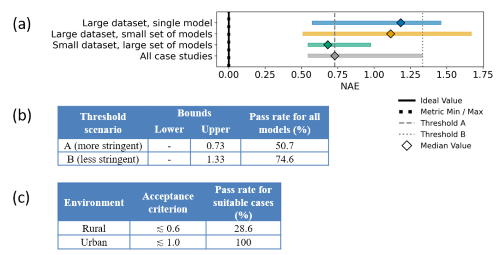
CERC have recently completed the study 'A review of methods used to assess the performance of atmospheric dispersion models', commissioned by the UK Atmospheric Dispersion Modelling Liaison Committee (ADMLC). The report provides a comprehensive review, covering evaluation methods and their suitability for different modelling applications. The study analysed 70 evaluation metrics across nine case studies and more than 30 models. Statistical metric thresholds for "acceptable" model performance have been proposed for non dimensional metrics, with more and less stringent criteria suggested where possible. Proposed thresholds were also compared with established acceptance criteria. CERC's freely available Model Evaluation Toolkit was used to perform the statistical calculations, and the updated version of this tool will be available in due course.
The full report can be accessed here.
A related in-person workshop has been organised for the 11th June 2026, with the aim of gathering feedback from the atmospheric dispersion modelling community on the suitability of the threshold criteria proposed in the study. The workshop agenda is available here. Sign up by completing this form: https://forms.cloud.microsoft/e/6MRPrW3Yzg
The image shows an example of calculating thresholds for Normalised Absolute Error (NAE): (a) interquartile range results of NAE for the evaluated case studies, (b) these results presented in tabulated form, and (c) case studies assessed against acceptance criteria from Chang & Hanna (2004, 2012).
11 May 2026Workshop on Atmospheric Dispersion Model Evaluation Methods and Tools
The Atmospheric Dispersion Modelling Liaison Committee (ADMLC), in collaboration with CERC, are hosting a workshop focused on atmospheric dispersion model evaluation metrics, including new proposals for model performance threshold criteria. Further information, including the workshop agenda, is given here.
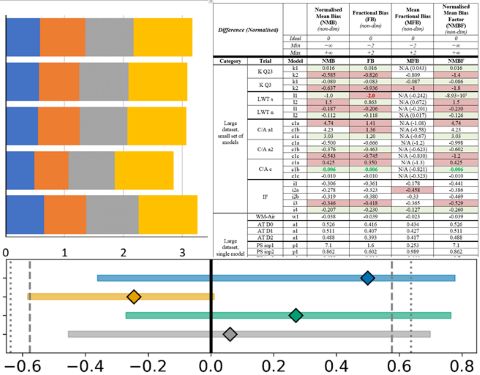
The workshop builds on the outcomes of a recent ADMLC-commissioned study by CERC, which reviewed a wide range of statistical and graphical methods used in atmospheric dispersion model evaluation. The study analysed 70 evaluation metrics across nine case studies and more than 30 models, covering applications such as regulatory assessment, compliance, accidental release and air quality forecasting.
A key outcome of the project is proposed performance threshold criteria for a large number of non-dimensional model evaluation metrics. Where possible, the study compares thresholds to criteria already used within the atmospheric dispersion modelling community e.g. from Chang and Hanna (2004, 2012). This workshop will provide an opportunity to:
- Present proposed threshold criteria and associated derivation methodologies
- Discuss threshold suitability and applicability across different modelling contexts
- Gather feedback to support potential adoption within the atmospheric dispersion modelling community
CERC will also showcase the Model Evaluation Toolkit, which was used to perform the case study model evaluation calculations. The Toolkit calculates the wide range of statistical metrics presented in the report and generates supporting graphics. It is available as a free resource to support consistent model evaluation practices. A new version will be released before the workshop.
This workshop is for practitioners, researchers and regulators involved in atmospheric dispersion model evaluation who are interested in improving the consistency and robustness of their techniques. There is no charge for the event but registration is required.
- Thursday 11 June 2026, 10:00‐16:00
- Harwell, Oxfordshire
- Please register by completing this form: https://forms.cloud.microsoft/e/6MRPrW3Yzg
- Deadline: Thursday 21 May 2026
The image shows examples of the types of figures and tables presented in the report: a decomposed error metric; metric results tabulated for all case studies; a boxplot for calculating proposed thresholds.
You can also follow CERC news on Facebook, X, LinkedIn and by RSS.
< Previous12345678910111213141516171819Next >