
CERC — Environmental Software and Services
- Overview
- Choosing a model
- Air pollution modelling
- ADMS 6
- ADMS-Roads (Extra)
- ADMS-Urban
- MAQS
- ADMS-Airport
- ADMS-Screen
- Feature comparison
- Emissions management
- EMIT
- Wind energy and airflow
- FLOWSTAR-Energy
- Accidental releases
- GASTAR
- LSMS
- ADMS-Puff
- ADMS-STAR
- Managing model runs
- Run Manager
- Model evaluation
- Model Evaluation Toolkit
- Meteorological data processing
- WRFtoMet
- Related Documentation
- User guides
- Technical specifications
- Model validation
- Newsletters
- Publications
- CERC co-author publications
- CERC software publications
- Presentations
- Other information
- Traffic emissions
- Prices
- Free demo
- Visualisation tools
- Current software versions
- System requirements


ADMS 6
World leading software for modelling industrial air pollution
Model options
ADMS 6 include the following options:

- Plume rise, source buoyancy and momentum
- Dispersion around buildings
- Flow over complex terrain
- Dry and wet deposition
- Time varying emissions
- Odours
- NOx chemistry
- Amine chemistry
- Plume temperature and humidity output
- Plume visibility
- Impact of wind turbines on dispersion
- Fluctuations
- Radioactive decay and γ-ray dose
- Plumes or puffs
- Dispersion in coastal areas
- Dispersion in offshore areas
- Calm conditions
- Changes in surface roughness
- Link to AERMOD
Plume rise, source buoyancy and momentum[top]
ADMS 6 uses a Runge-Kutta method to solve the conservation equations to estimate plume rise. This allows greater scope to include advanced model options than the Briggs empirical expression used in other Gaussian type models. The ADMS 6 method takes into account the effect on the plume of the source buoyancy and momentum, and includes the penetration of boundary layer inversions.
Dispersion around buildings[top]

The building effects module in ADMS 6 includes the following features.
Up to 25 buildings can be included in each model run with a Main Building being defined for each source. For each wind direction, a single effective wind-aligned building is defined, around which the flow is modelled.
The flow field consists of a recirculating region (or cavity), with a diminishing turbulent wake downstream.
Concentrations for the cavity, CR, are uniform, and based on the fraction of the release that is entrained. The concentration at a point further downwind is the sum of contributions from two plumes: a ground-based plume from the recirculating flow region and an elevated plume from the non-entrained remainder. The concentration and deposition are set to zero within the user-defined buildings.
Flow over complex terrain[top]

ADMS 6 uses CERC's FLOWSTAR, to calculate how the mean airflow and turbulence and hence dispersion and pollutant concentrations are changed over complex terrain.
The model predicts a three-dimensional flow and turbulence field over the region of interest, dependent on input values for the spatial variation of both the terrain height and surface roughness, as well as the local meteorological conditions.
Usually it is advisable to include terrain height effects if the gradients exceed 1:10 in the model domain. The model can typically be used for gradients up to about 1:2 but may not be reliable close to isolated slopes with higher gradients or more generally if large parts of the modelling domain have slopes greater than 1:2. The influence of the terrain will vary with the source height and position and the local meteorology.
Dry and wet deposition[top]
The rate of dry and wet deposition to the ground can be modelled in ADMS 6. Dry deposition is assumed to be proportional to the near-surface concentration, and deposition velocities can either be entered by the user, or estimated by the model. Wet deposition is modelled through a washout coefficient; irreversible uptake is assumed, and plume strength following wet deposition decreases with downwind distance. There is also an advanced 'falling drop' option for wet deposition of SO2 and HCl which calculates the rate of dissolution and/or degassing in rain drops
Time varying emissions[top]
Emission rates from sources are rarely constant. The variation of the emission rate with time can be modelled in ADMS 6, in addition to corresponding variations in emission temperature, volume flow rate (or exit velocity), source diameter, and plume water content.
Odours[top]
Odours are an important issue in areas where emission sites are located close to residential areas. The dispersion of odours can modelled using ADMS 6. Odour release rates and concentrations are specified/calculated in odour units of ouE which are a mass measure.
NOx chemistry[top]
The chemistry scheme in ADMS 6 considers the following fast reactions involving NOx and ozone (O3) to determine the NO2 concentration in the dispersing plume(s):
NO + O3 → NO2 + O2
and a reverse reaction (day time only, hν depends on UV radiation intensity)
NO2 + hν → NO + O3
Model validation has shown the method to be more accurate than empirically based formulations.

Amine chemistry[top]
An additional advanced model option allows for chemical reactions of amines to form nitramines and nitrosamines in the atmosphere. The module has been developed as a consequence of technologies for Carbon Capture and Storage (CCS), involving amine solvents.
An additional user-friendly tool to help model users calculate the amine-related input parameters is also available for download. (.xlsm, <1MB)
A User Guide for the tool can be accessed here.
A summary of the research behind the amine chemistry scheme in ADMS can be found in the Carbon Capture and Storage modelling section.
Plume temperature and humidity output[top]
ADMS 6 can calculate the plume-affected temperature, specific humidity and/or relative humidity at each output point.
Plume visibility[top]
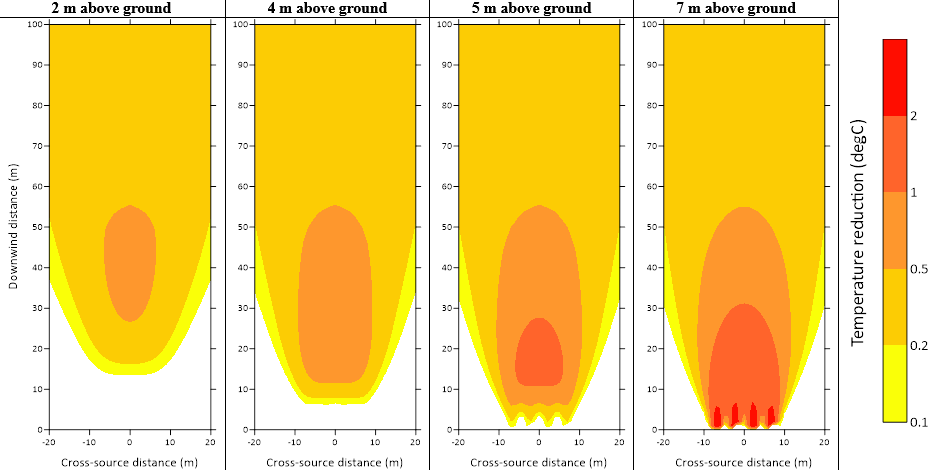
The plume visibility module uses the initial water content of the release and the humidity of the ambient air to determine whether the plume will be visible due to condensed water droplets at each downstream distance. The effect of water on the plume density and the heating and cooling effects of condensation and evaporation are taken into account.
Impact of wind turbines on dispersion[top]
The model can allow for the effect on dispersion of one or more horizontal-axis three-bladed wind turbines in the neighbourhood of an emission source.
Fluctuations[top]
ADMS 6 is the only regulatory model of its kind to model short time scale fluctuations allowing the calculation of the probability distributions of pollutant concentrations, probabilities of exceedence of specified threshold, and the range of concentration for averaging time as little as a second. The module has applications where estimates of the occurrence of peaks of concentration over short averaging times are important (e.g. odours, flammable & toxic accidental, 15 minute air quality objective for SO2). The module takes into account variations due to both turbulence and changes in meteorology.
Radioactive decay and γ-ray dose[top]
ADMS 6 includes a radioactivity module that predicts the decay of radioactive species released from a source. Users may enter up to 10 parent isotopes in any model run, and up to 50 isotopes (parents and daughters) will be output. Half-lives of over 800 isotopes are included in the model and ADMS 6 can also calculate the associated levels of γ-ray dose.
Plumes or puffs[top]
ADMS 6 can model both continuous releases, i.e. plumes, in addition to instantaneous and time-dependent releases, i.e. puffs.
Dispersion in coastal areas[top]
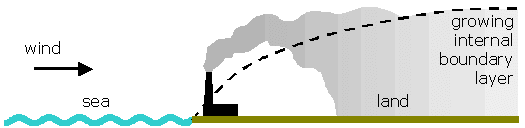
For air dispersion modelling in coastal areas, ADMS 6 includes a coastline module to take account of increasing boundary layer height when airflow is from the sea to the land. It may be invoked when the following conditions are satisfied:
- the sea is colder than the land;
- there are convective meteorological conditions on land;
- there is an onshore wind.
Dispersion in offshore areas[top]
ADMS 6 includes a marine boundary layer scheme for calculating surface roughness and heat fluxes over the sea, which could be used, for example, for dispersion modelling of emissions from stacks on oil platforms.
Calm conditions[top]
ADMS 6 includes an option to model ‘calm’ meteorological data which, in standard ADMS 6 runs, are not modelled.
The direction of the wind becomes more variable for lower mean wind speeds. The approach used for calm conditions is to calculate the concentration as a weighted average of a normal 'Gaussian' type plume and a radially symmetric plume, where the weighting depends on the wind speed. The radially symmetric plume assumes equal probability of all wind directions.
Changes in surface roughness[top]
ADMS 6 can consider the spatial variation of surface roughness on plume dispersion.
Link to AERMOD[top]
There is a facility to run the main options of AERMOD including the option of using the AERMET meteorological processor.