
CERC — Environmental Software and Services
- Overview
- Air pollution modelling
- ADMS 6
- ADMS-Roads (Extra)
- ADMS-Urban
- MAQS
- ADMS-Airport
- ADMS-Screen
- Feature comparison
- Emissions management
- EMIT
- Wind energy and airflow
- FLOWSTAR-Energy
- Accidental releases
- GASTAR
- LSMS
- ADMS-Puff
- ADMS-STAR
- Managing model runs
- Run Manager
- Model evaluation
- Model Evaluation Toolkit
- Meteorological data processing
- WRFtoMet
- Related Documentation
- User guides
- Technical specifications
- Model validation
- Newsletters
- Publications
- CERC co-author publications
- CERC software publications
- Presentations
- Other information
- Traffic emissions
- Prices
- Free demo
- Visualisation tools
- Current software versions
- System requirements


FLOWSTAR-Energy
High resolution air flow for wind farm assessments
Quick links:
What is FLOWSTAR-Energy?
How can FLOWSTAR-Energy help you?
What are the benefits of FLOWSTAR-Energy?
How does FLOWSTAR-Energy work?
What is FLOWSTAR-Energy?
FLOWSTAR-Energy is a practical, high resolution model that simulates air flow and turbulence over flat or complex terrain, including the effects of stratification, variable surface roughness and wind turbines in operation. FLOWSTAR-Energy is an extended version of the FLOWSTAR model of flow over complex terrain; FLOWSTAR-Energy provides the flow field and turbulence output familiar to users of FLOWSTAR and in addition provides a range of essential outputs for wind farm planning, including estimates of free stream, gross and net energy yields. The model simulates wind turbine wakes, their interaction and their effect on the flow field and wind energy resource. FLOWSTAR-Energy can be used at scales from 5 metres up to 60 kilometres.
The following pictures illustrate a few of the type of outputs that are available from FLOWSTAR-Energy, either directly (examples A, B and E) or after simple manipulation of numerical output in a package like Excel (examples C, D and F):
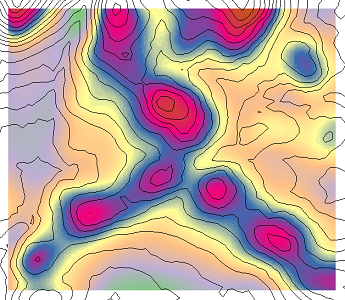
A) Annual wind energy yield map over complex terrain
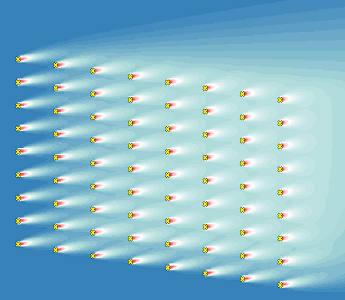
B) Map of wind speed within a wind farm
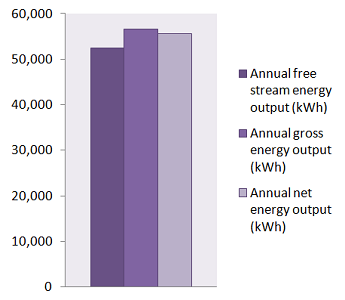
C) Predicted annual energy yield

D) Wind farm array efficiency for different wind speeds and wind directions
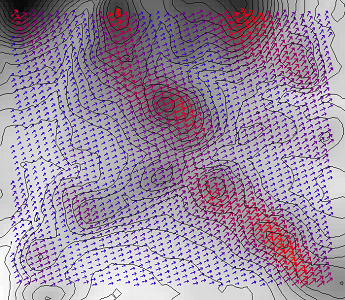
E) Flow field map over complex terrain

F) Time series of hourly predicted wind speed and power
How can FLOWSTAR-Energy help you? [top]
Here are some scenarios where FLOWSTAR-Energy would provide an excellent modelling solution:
Where is the best place to site a single wind turbine?
FLOWSTAR-Energy can model local flow and turbulence using either wind climate data or up to 10 years of hourly meteorological data to provide a map of total energy yields across your flat or hilly site for your choice of wind turbine make and type, enabling you to choose your preferred site.
What will be the net energy yield of your wind farm?
FLOWSTAR-Energy can model local flow and turbulence to provide an estimate of free stream, gross and net energy yields over the period for each individual wind turbine and for the wind farm as a whole, taking into account wind turbine wake interaction. Onshore and offshore sites can be assessed.
What impact will a proposed wind farm nearby have on the energy yield of your wind farm?
FLOWSTAR-Energy can model local flow and turbulence for particular wind speed and wind direction cases with and without the proposed scheme, providing estimates of the impact of the proposed scheme on wind speed and energy yield for wind turbines in the existing wind farm.
You need an automatic short-term forecast of wind energy yield for your wind farm over the next few days.
A system using FLOWSTAR-Energy can model local flow and turbulence using forecast meteorological data, predicting free stream, gross and net energy yields for individual turbines and the wind farm as a whole for each hour of the forecast. More details are available here.
What impact will a nearby forest have on your wind farm’s energy yield?
FLOWSTAR-Energy can model the effect of the forest on local flow and turbulence, providing an estimate of the effect of the forest on wind energy yields.
What is the wind flow and turbulence in the proximity of your bridge/mast?
FLOWSTAR-Energy can model local flow and turbulence, including the effect of hills, wind turbines in operation and any significant land use features (e.g. forestry) to provide a 3D estimate of wind flow and turbulence in the proximity of a wind-sensitive structure.
Which parts of your forest are most exposed to destructive winds?
FLOWSTAR-Energy can model local flow and turbulence, including the effect of hills, and provide a map of wind speed across the area of concern.
What are the benefits of FLOWSTAR-Energy? [top]
| Range of essential outputs | ‘Flow field output’ provides a 3D estimate of flow and turbulence over the local area at the resolution of your choice and/or at specific locations. Results can either be obtained for each met condition modelled or as an average over the whole period. |
|---|---|
| ‘Potential wind energy output’ provides a map of wind speed and wind energy for the wind turbine make and type of your choice across the local area at the resolution of your choice and/or at specific locations of your choice. Results can either be obtained for each met condition modelled or as average wind speed and total wind energy over the whole period. | |
| ‘Wind farm output’ provides free stream, gross and net wind speed, energy yield and capacity factor for individual wind turbines within a wind farm and for the wind farm as a whole. Results can either be obtained for each met condition modelled or as average wind speed and total wind energy over the whole period. | |
| ‘Free stream boundary layer profile output’ provides vertical profiles of free stream wind speed, turbulence components and other atmospheric boundary layer characteristics for each met condition modelled. | |
| Easy to use | An intuitive design and integrated map view make FLOWSTAR-Energy easy to use. |
| FLOWSTAR-Energy is provided with a full digital User Guide providing detailed descriptions of all the model features, as well as worked examples. | |
| CERC prides itself on its outstanding support services; the Helpdesk service gives you access to experienced consultants and model developers; training courses are available on request. | |
| Advanced options | Offshore sites can be modelled using marine parameters to more accurately calculate atmospheric boundary layer parameters over the sea. |
| Measured free stream vertical profiles of wind and turbulence can be used in place of standard FLOWSTAR-Energy profiles. |
How does FLOWSTAR-Energy work? [top]
The FLOWSTAR-Energy model of wind turbine wake development exploits similarities between the decay of the wake behind a wind turbine (characterised by a region of reduced wind speed) and the dispersion of a plume of passive gas emitted from an elevated source. FLOWSTAR-Energy has been validated against measured datasets from the Nysted and Noordzee wind farms and from a test turbine at Tjæreborg in Denmark.
The FLOWSTAR model is derived from the theoretical work of Jackson and Hunt1, and Hunt et al2,3. The model is based on the premise that different processes dominate the flow dynamics in layers at different heights above the ground; thus in the inner layer shear stress perturbations are locally important and are described by a mixing length closure whilst the flow is also impacted upon by pressure gradients. These are determined from the outer layer flow where stratification plays an important role but where shear stress perturbations have little influence. There is a transitional or middle layer between the inner and outer layer.
1 Jackson PS and Hunt JCR,1975:Turbulent wind flow over a low hill.Quart. J. R. Met. Soc., 101, 929-955.
2 Hunt JCR, Leibovich S and Richards KJ,1988:Turbulent shear flow over hills.Quart. J. Roy. Meteo. Soc., 114, 1435-1470.
3 Hunt JCR, Leibovich S and Lumley JL,1981:Prediction method for the dispersal of atmospheric pollutant in complex terrain.Technical Report P85-81-04, Flow Analysis Associates, Ithaca, NY.