
CERC — Environmental Software and Services

- Overview
- Choosing a model
- Air pollution modelling
- ADMS 6
- ADMS-Roads (Extra)
- ADMS-Urban
- MAQS
- ADMS-Airport
- ADMS-Screen
- Feature comparison
- Emissions management
- ADMS-EIT
- EMIT
- Wind energy and airflow
- FLOWSTAR-Energy
- Accidental releases
- GASTAR
- LSMS
- ADMS-Puff
- ADMS-STAR
- Managing model runs
- Run Manager
- Model evaluation
- Model Evaluation Toolkit
- Meteorological data processing
- WRFtoMet
- Related Documentation
- User guides
- Technical specifications
- Model validation
- Newsletters
- Publications
- CERC co-author publications
- CERC software publications
- Presentations
- Other information
- Traffic emissions
- Prices
- Free demo
- Visualisation tools
- Current software versions
- System requirements
ADMS-EIT
Advanced tool for inferring atmospheric emissions from ambient measurements
What is ADMS-EIT?
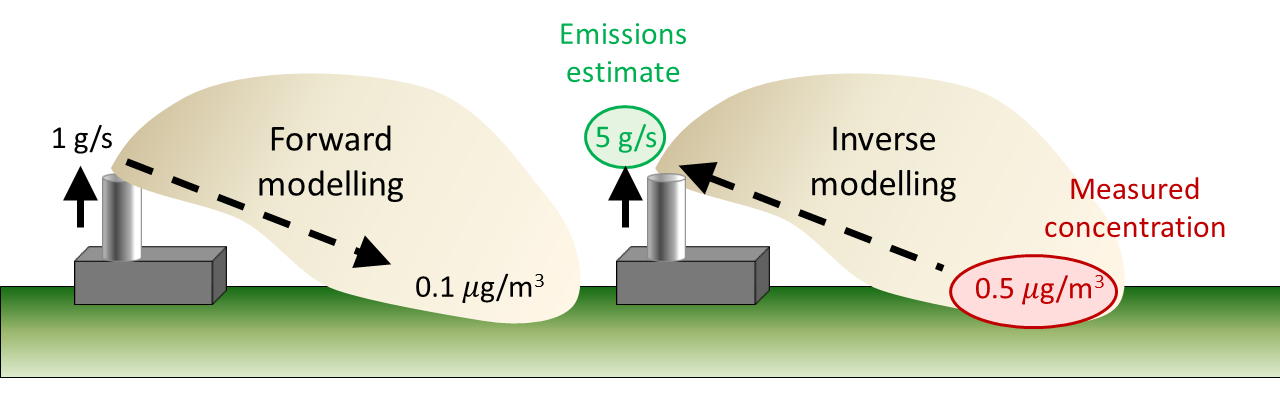
Schematic of the ADMS-EIT inversion process. Initial emission rate estimates are used as input to a dispersion model to calculate concentrations at monitoring locations. The resulting modelled concentrations are combined with measured concentrations using Bayesian inference to derive improved emission rate estimates.
ADMS-EIT (ADMS-Emissions Inference Tool) is an advanced tool that uses a Bayesian inversion technique to optimise emission rates of pollutants using measured concentrations and modelled concentrations from an atmospheric dispersion model. The tool takes account of uncertainties in both emissions and measurements. Pollutants typically considered include greenhouse gases and regulated air quality pollutants.
Typical applications include:
- Refining pollution source emission rate estimates where an initial estimate is available;
- Estimating emission rates where limited or no information on emissions exists;
- Identifying differences between assumed and observed emissions to support emissions inventory development and dispersion model evaluation.
The tool is designed for use with output files generated by the ADMS suite of advanced atmospheric dispersion models. However, output from other dispersion models may be used by appropriately converting the input data.
Who uses ADMS-EIT?
ADMS-EIT has been developed for organisations and specialists involved in estimating or refining air pollutant emissions (for example greenhouse gases, air quality pollutants) and in dispersion modelling. Typical uses include:
- Environmental consultancies: Use monitoring data to refine emissions estimates, improve emissions inventories and support environmental impact assessments;
- Local authorities: Improve estimates of emissions from road traffic and other local sources to support air quality modelling, management and policy development;
- Environmental regulators and government agencies: Quantify emissions from regulated sites, for example methane and hydrogen sulphide emissions from landfill sites;
- Research institutions and universities: Apply and evaluate inverse modelling techniques, investigate atmospheric emissions and make better use of monitoring data, including data from toxic pollutants for which emissions may be poorly quantified such as ultra-fine particles (UFP), and greenhouse gases;
- Emissions inventory developers: Compare inventory estimates with emissions inferred from measurements to identify and investigate potential discrepancies.
Why use ADMS-EIT?
ADMS-EIT offers several advantages for inverse modelling, including:
- It is directly compatible with the world-leading ADMS 6 and ADMS-Urban dispersion models, which facilitates inverse modelling in relation to the full range of pollution sources (point, road, area, diffuse).
- The Bayesian approach to inverse modelling allows users to:
- Account for multiple sources;
- Specify uncertainty in relation to both emissions and measurement data inputs;
- Represent co-variance in emissions between different sources and over time.
- It allows for background concentrations, and their associated uncertainty.
- It has a user-friendly interface, comprehensive User Guide and, as with all CERC software, licenced users can access support through the Helpdesk service, and training is available.