
CERC — Environmental Software and Services
- Overview
- Choosing a model
- Air pollution modelling
- ADMS 6
- ADMS-Roads (Extra)
- ADMS-Urban
- MAQS
- ADMS-Airport
- ADMS-Screen
- Feature comparison
- Emissions management
- ADMS-EIT
- EMIT
- Wind energy and airflow
- FLOWSTAR-Energy
- Accidental releases
- GASTAR
- LSMS
- ADMS-Puff
- ADMS-STAR
- Managing model runs
- Run Manager
- Model evaluation
- Model Evaluation Toolkit
- Meteorological data processing
- WRFtoMet
- Related Documentation
- User guides
- Technical specifications
- Model validation
- Newsletters
- Publications
- CERC co-author publications
- CERC software publications
- Presentations
- Other information
- Traffic emissions
- Prices
- Free demo
- Visualisation tools
- Current software versions
- System requirements
ADMS-EIT
Advanced tool for inferring atmospheric emissions from ambient measurements
Input data
ADMS-EIT requires modelled and measured concentrations and initial estimates of emissions and their associated uncertainties. The main input datasets are:
Modelled concentrations
- The tool is compatible with output from the ADMS 6 and ADMS-Urban dispersion models, where the ADMS model results are calculated using unit emission rates for each source (.sst file). This ADMS model output file provides the modelled contribution from each source at each receptor location where a measurement is available. Data from alternative dispersion models can also be used as input.
Initial emissions estimates
- Initial emission rate estimates and associated uncertainties for all sources, which can include explicit sources, such as roads, point, line, area, volume and aircraft sources, as well as (residual) gridded emissions representing more diffuse or poorly defined sources. Where initial emissions estimates are unavailable, an arbitrary value can be used with an associated high uncertainty value.
- Gridded emissions, which can be assigned to different sectors, allowing different uncertainties and temporal patterns to be used.
- Emissions, which can be specified as constant or time-varying.
- Common sources of emissions uncertainty (for example, road traffic emissions calculated using emission factors), which can be accounted for by assigning error covariance factors to certain source types.
Monitoring data
- Measured pollutant concentrations at monitoring locations, together with estimates of measurement uncertainty.
- Different monitor types, which can be included in the same analysis, with separate uncertainty assumptions for each type.
Background concentrations
- Background pollutant concentrations and their associated uncertainty. These account for pollutant concentrations not explained by the modelled sources, for example contributions from long-range transport.
Advanced options
- An optional time covariance matrix can be used to account for relationships between different modelled hours, for example, recurring emission patterns at the same time on different days (for example traffic).
- Further options are available for the treatment of outliers and negative emissions. Negative emissions can occur when the absorption of a pollutant exceeds its release, resulting in a net negative emission rate, such as CO2 absorption by growing crops through photosynthesis.
Output data
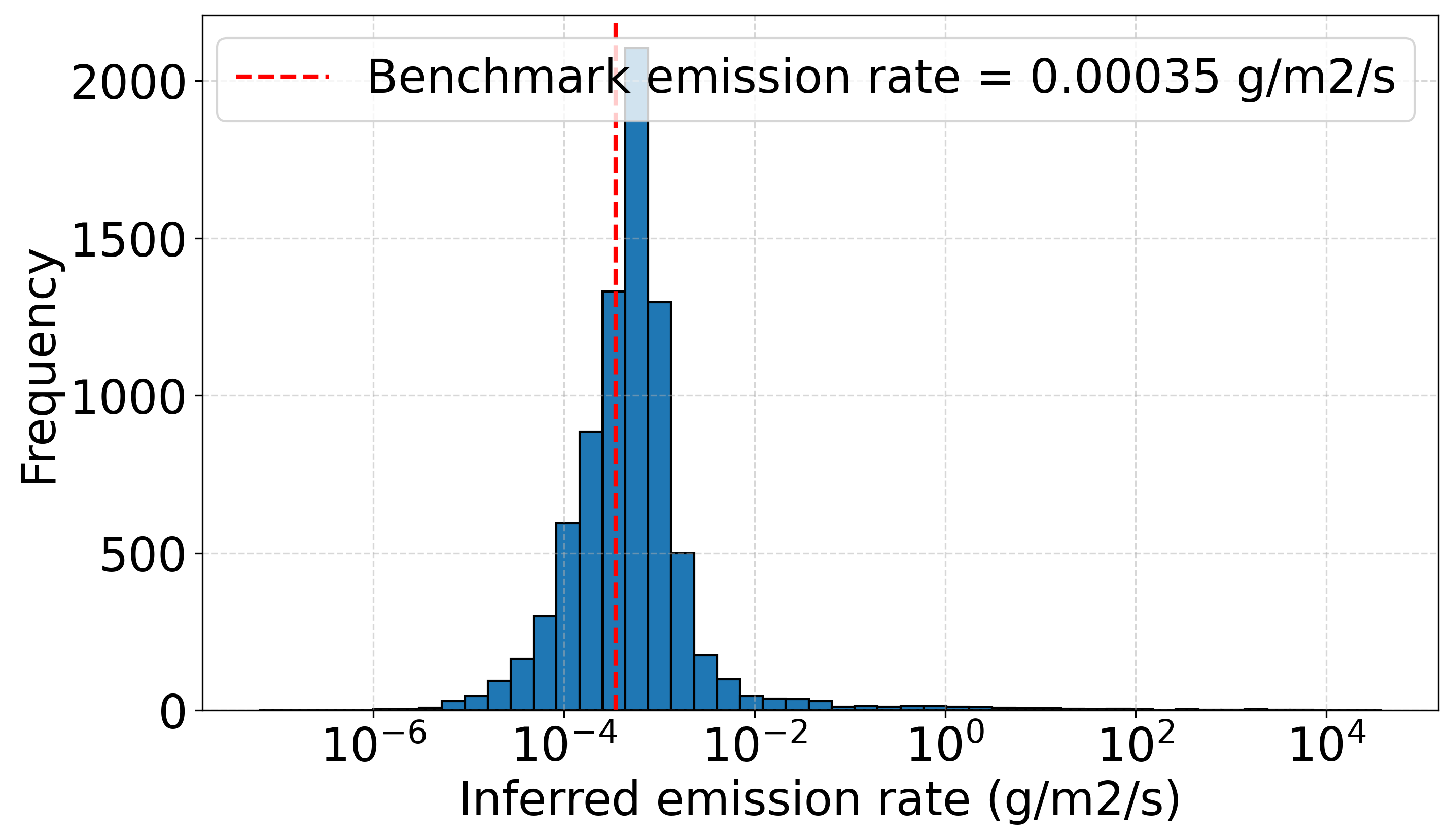
Histogram of inferred hourly emission rates, starting from an unknown input emission rate, compared with the reported benchmark emission rate. The inferred emission rate distribution shows hourly variability and is centred on the benchmark value, demonstrating the ability of ADMS-EIT to derive improved emission rate estimates.
ADMS-EIT generates a range of output files containing emissions and concentration data. Output is grouped into the following categories:
Hourly data
Options allow separate output files to be generated containing emissions and concentrations for each hour for the calculation period.
Output includes:
- Input and inferred emissions for each source;
- Initial modelled, inferred modelled, and observed concentrations at each monitor.
Concentration results may additionally be grouped by source type. Units can be chosen by the user to match the intended application of the results.
Averaged data
Options allow separate output files to be generated containing average emissions by source and source type, monthly emission factors, and hourly emission factors.
Output includes:
- Input and inferred emissions values;
- Summary statistics, such as the percentage difference between input and inferred emissions and the number of hours or data points included in the calculations.
For temporal profile output, results are provided for each month, hour of the day, and day of the week, as appropriate.
ADMS files
Options allow output files to be generated containing emissions and background concentration data in a format suitable for use as input to ADMS models.
Output includes:
- Explicit sources in .spt file format;
- Grid source data in 3D netCDF file format;
- Hourly emission factors in .hfc file format;
- Background concentration values in .bgd file format.
Advanced data
Options allow advanced output files to be generated containing diagnostic information on the emission inference process.