
CERC — Environmental Software and Services
Suitability of ADMS-Urban and MAQS for modelling under the EU Air Quality Directive 2024/2881
CERC's air quality modelling software is ideally placed to be used under Directive (EU) 2024/2881. Here, an overview of the Directive’s requirements for air quality modelling is provided, the suitability of CERC’s software, ADMS-Urban and MAQS, to meet these requirements is demonstrated, and case studies showing practical applications of the software are presented.
General requirements for air quality modelling under EU AAQD 2024/2881
Importance of modelling
Directive (EU) 2024/2881 is the latest European Union (EU) Ambient Air Quality Directive (AAQD) establishing a comprehensive regulatory framework aimed at eliminating the harmful effects of air pollution on human health and the environment by 2050.
The directive consolidates and replaces Directives 2008/50/EC and 2004/107/EC, introducing stricter air quality standards together with strengthened requirements for planning, monitoring, and enforcement. Of particular relevance is the significantly enhanced role of modelling applications. The directive contains 79 references to modelling, compared with 21 and 12 in the two preceding directives, respectively, clearly demonstrating the growing importance attributed to modelling. This importance is further underscored by the publication of the Air quality modelling for air quality policy document, which provides detailed technical guidance to support the implementation of air quality modelling under the new Directive.
Under Directive (EU) 2024/2881, air quality modelling plays a central role across several key applications, including:
- Air Quality Assessment: providing information on the spatial distribution and levels of air pollution
- Spatial Representativeness: informing the assessment of spatial representativeness and the design of monitoring networks
- Source Apportionment: assessing the links between emission sources and observed air pollution levels and peaks
- Air Quality Planning: quantifying the impacts of planned or implemented emissions reduction measures
- Forecasting: delivering short-term projections of air pollution levels.
CERC has extensive expertise in air quality modelling and associated applications. CERC software, which includes the Atmospheric Dispersion Modelling System (ADMS), is world renowned, with hundreds of users in the UK, Europe and globally.
ADMS-Urban is the most comprehensive dispersion model within the ADMS suite. It is suitable for air quality studies of complex urban environments due to its ability to describe in detail the dispersion on a range of scales, from street level to city-wide, while considering the entire range of relevant emission sources. Its sister model, ADMS-Airport, additionally allows for detailed modelling of aircraft emissions.
The Multi-Model Air Quality System (MAQS) is an automated multi-scale air quality modelling system that couples the street scale-resolution ADMS-Urban model to regional model datasets. MAQS combines these regional and local concentrations in such a way as to minimise double-counting of emissions and to ensure that the chemical processes are accounted for at all timescales while remaining computationally efficient and user-friendly.
MAQS directly supports a number of regional meteorological and chemical transport model file formats, specifically:
- Meteorology: WRF
- Emissions: CMAQ and WRF-Chem
- Concentrations: CMAQ, CAMx, CHIMERE, EMEP and WRF-Chem.
Meteorology, emissions and concentrations data from other models can be used in conjunction with MAQS, but datasets need to be converted into generic input file formats (2D or 3D). The MAQS User Guide provides further details.
General requirements for air quality modelling under EU AAQD 2024/2881
Directive (EU) 2024/2881 places a strong emphasis on the use of modelling applications. Modelling is referenced 79 times across Articles 5, 7, 8, 9, 11 and 15 as well as in Annexes IV, V, VI, VII and X. The Directive introduces more sophisticated monitoring and assessment regimes, which explicitly strengthen the role of modelling to ensure continuity of measurements (in case a fixed monitor needs to be moved from the current location) and improved spatial representativeness for the following pollutants: sulphur dioxide, nitrogen dioxide and oxides of nitrogen, particulate matter (PM10 and PM2.5), benzene, carbon monoxide, arsenic, cadmium, lead, nickel, benzo(a)pyrene and ozone.
In this context, the following terminology should be considered:
- Assessment thresholds are pollutant concentration limits that determine the assessment method required for each zone. Depending on whether pollutant concentrations are below or above the threshold, the assessment method may rely on fixed continuous measurements, air quality modelling, indicative measurements, or a combination thereof
- Limit Value (LV) is a legally binding pollutant concentration value, set to protect human health, that must not be breached
- Target Value (TV) is a pollutant concentration value set to avoid long-term harmful effects. It is less strict than an LV, as it is required to be attained only when the necessary measures required to reach it do not incur disproportionate cost.
In contrast to Directives 2008/50/EC and 2004/107/EC, the revised Directive strengthens the role of supplementary assessment methods, such as air quality modelling and indicative measurements, in all zones where pollutant concentrations exceed a relevant LV or TV. From 2028, the use of these supplementary assessment methods, in combination with fixed measurements, will become mandatory in such zones.
Threshold exceedances
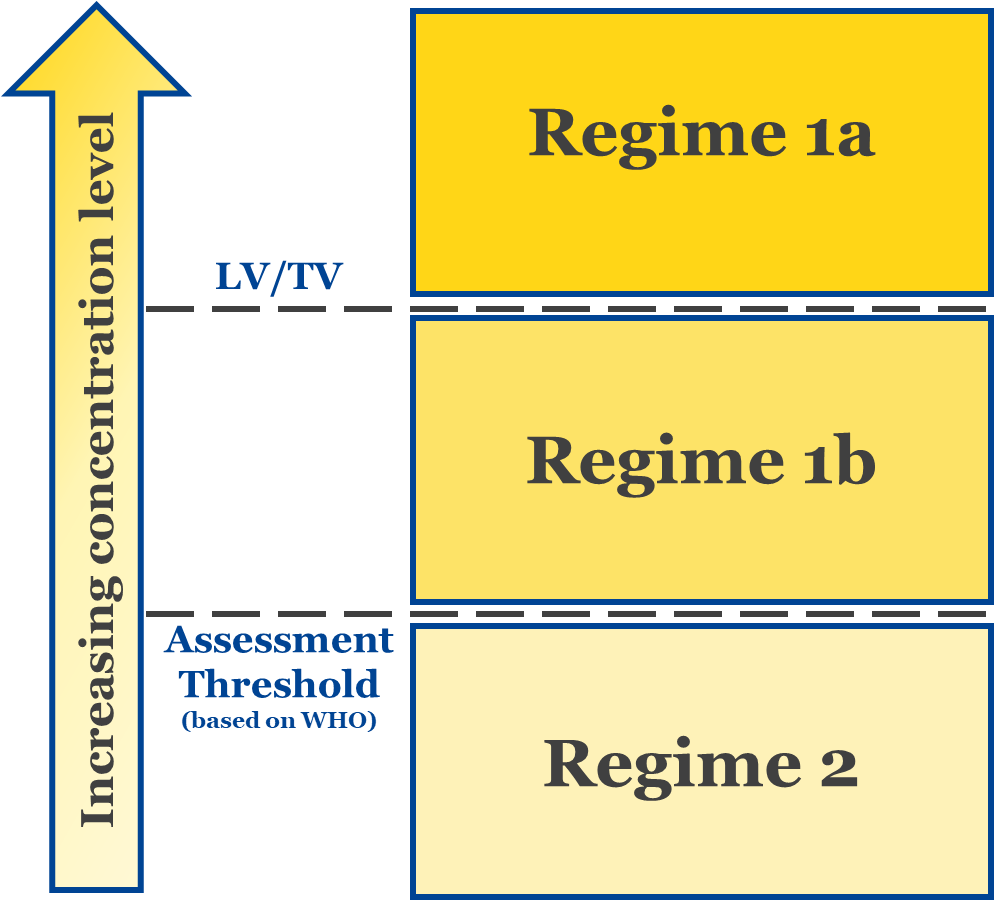
Diagram summarising the assessment regimes defined in Directive (EU) 2024/2881. Regime 1a applies to zones where the pollutant concentrations exceed the relevant LV or TV, Regime 1b where concentrations remain below these values despite exceeding the assessment threshold and Regime 2 where concentrations are below the assessment threshold. Adapted from The revised Ambient Air Quality Directive, a presentation given by the European Commission at the FAIRMODE meeting, March 2025.
In all zones where pollutant assessment thresholds are exceeded, ambient air quality must be assessed using fixed measurements. These may be supplemented by modelling applications to provide additional information on spatial distribution and the spatial representativeness of fixed monitoring sites (Regimes 1a and 1b).
In zones where pollutant levels exceed the relevant assessment threshold but remain below the applicable LV, TV, or critical level (corresponding to Regime 1b), the number of fixed measurement sites can be reduced by up to 50%. This reduction can be achieved provided that modelling applications and/or indicative measurements are used and that the information obtained is sufficient to adequately assess air quality.
From 2028, modelling applications, or indicative measurement, must also be used in addition to fixed measurements in areas where pollutant levels exceed an LV or TV, corresponding to Regime 1a.
In zones classified as below the assessment threshold, modelling applications, indicative measurements, objective estimation or a combination of the listed techniques are sufficient for ambient air quality assessment (Regime 2).
Spatial representativeness
Modelling applications should be used to provide information on the spatial representativeness of fixed measurements. In this context, modelling must be done at least every five years. Where modelling identifies an exceedance of an LV or TV in areas not covered by fixed measurements (or their spatial representativeness), the directive requires installation of at least one additional fixed or indicative measurement site at the air pollution hotspot(s) identified by the modelling.
Air quality roadmaps and plans
Where pollutant levels exceed any LV or TV in a particular zone, the Directive requires the development of air quality roadmaps and plans. Modelling can be used to understand the reasons for exceedances, for example by undertaking source apportionment, and to provide evidence for the likely impact of air quality control measures.
- Roadmaps: For the period from 1 January 2026 to 31 December 2029, where pollutant levels in a zone exceed any LV or TV to be attained by 1 January 2030, air quality roadmaps for the relevant pollutant must be developed. The roadmap must define measures to ensure compliance by the applicable attainment deadline.
- Air quality plans: Where pollutant levels exceed any LV or TV, air quality plans need to set out appropriate measures to achieve compliance. The exceedance period must be kept as short as possible.